Our Hardwood Floor Salvage Approach
Weighted Drying Systems
Floor-specific weighted mats apply controlled pressure during drying to help cupped boards flatten as moisture equalizes — reducing permanent deformation.
Individual Floor Assessment
Every floor is evaluated separately using moisture meter readings and visual inspection. We never issue blanket replacement recommendations without data.
Controlled Dehumidification
LGR dehumidifiers maintain optimal room conditions throughout drying — preventing additional warping from uneven moisture loss across the board surface.
Honest Salvage vs. Replacement
If your floors can be saved, we tell you and explain the timeline. If replacement is the better option, we explain why and give you cost information for both — before any work begins.
What Water Does to Hardwood Floors Over Time
Hardwood flooring reacts to water differently depending on how much water is involved and how long the exposure lasts. Understanding this progression helps you evaluate your own situation:
First 1 to 6 hours: Water sits on the surface and begins seeping between boards and into the end grain. The finish provides some protection, but water finds its way through joints, nail holes, and any scratches or worn areas. The subfloor beneath begins absorbing moisture from below.
6 to 24 hours: Boards begin absorbing moisture unevenly. The bottom of the board — in contact with wet subfloor or underlayment — takes on more moisture than the top, which is exposed to air. This differential creates cupping: the edges of individual boards rise higher than the center, creating a washboard-like texture.
24 to 72 hours: Cupping may worsen as boards continue expanding. If expansion pressure exceeds the fastener holding force, boards can begin buckling — physically lifting away from the subfloor. In Austin's warm environment, mold can begin growing on the underside of boards and on the subfloor within this window.
Beyond 72 hours: Extended exposure leads to delamination in engineered hardwood (the veneer layer separates from the plywood core), staining from tannin bleed in oak and other species, and potential structural damage to the subfloor itself. Salvage becomes increasingly difficult the longer the wood remains wet.
Cupping vs. Buckling: What Each Means
Cupping is the more common form of hardwood water damage and the more treatable one. When you look across the floor at a low angle, cupped boards create a visible ripple pattern — each board is concave, with raised edges and a lower center. Cupping indicates a moisture imbalance between the top and bottom of the board.
The important thing about cupping: it is often reversible. As the wood dries and moisture content equalizes between the top and bottom surfaces, boards typically flatten on their own. This process can take several weeks to a few months depending on the wood species, board thickness, and environmental conditions. Rushing it — by sanding the raised edges before the wood has fully equalized — creates a permanent problem called crowning.
Buckling is more serious. Buckled boards have physically detached from the subfloor and may be raised an inch or more. This happens when wood expansion overwhelms the nails or adhesive holding the floor down. Buckling usually indicates heavier water exposure or longer exposure time than cupping alone.
Some buckled boards can be refastened and salvaged after drying, but the success rate is lower than with cupping. If the wood has twisted, cracked at the tongue-and-groove joint, or developed mold on the underside, replacement of those sections is typically the better option.
Water-Damaged Hardwood Floors? Get an Honest Assessment.
We assess each floor individually and tell you whether it can be saved — before recommending any work.
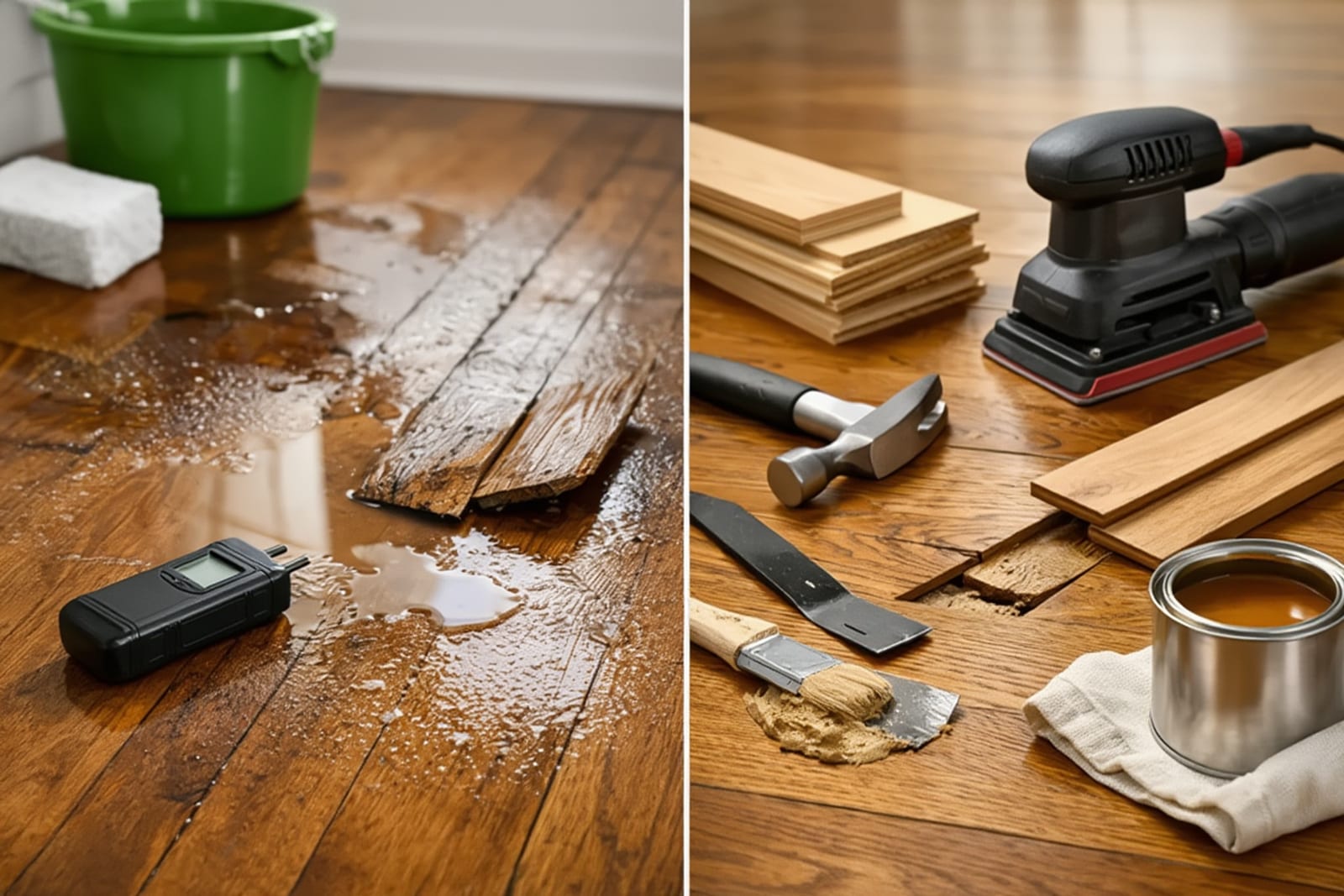
Assessing Whether Hardwood Floors Can Be Saved
The salvage decision depends on several measurable factors, not guesswork. Here is what we evaluate during a water damage assessment:
- Moisture content readings. We use pin-type moisture meters inserted into the wood to measure current moisture content and compare it to the expected equilibrium moisture content (EMC) for Austin — typically 8 to 10 percent depending on the season. Readings above 16 to 18 percent indicate significant saturation.
- Subfloor condition. On Austin's common slab foundations, the subfloor is often the slab itself with a moisture barrier. On pier-and-beam homes, plywood subfloor can swell, delaminate, or develop mold. Subfloor damage may necessitate floor removal even if the hardwood itself could be saved.
- Wood species and construction. Solid hardwood (3/4-inch oak, maple, hickory) has a higher salvage rate than engineered hardwood, which can delaminate irreversibly when the adhesive between layers fails. Species matters too: white oak is more water-resistant than red oak due to its closed-cell structure.
- Exposure duration. Floors that were standing in water for hours have lower salvage odds than floors affected by a slow leak that was caught early.
- Mold presence. Mold on the underside of boards or on the subfloor may require board removal for proper treatment, even if the wood itself is structurally sound.
We give you an honest assessment. If your floors can be saved through drying and refinishing, we tell you — and we explain the timeline and what to expect. If replacement is the more reliable option, we explain why and provide cost information for both approaches so you can decide.
The Drying Process for Hardwood Floors
Drying hardwood floors requires a different approach than drying walls or carpet. Wood is dense, dries slowly, and must be dried evenly to avoid permanent deformation.
Top-side drying uses high-velocity air movers positioned to create airflow across the floor surface. This accelerates evaporation from the top of the boards. However, top-side drying alone can actually worsen cupping by drying the top surface faster than the bottom.
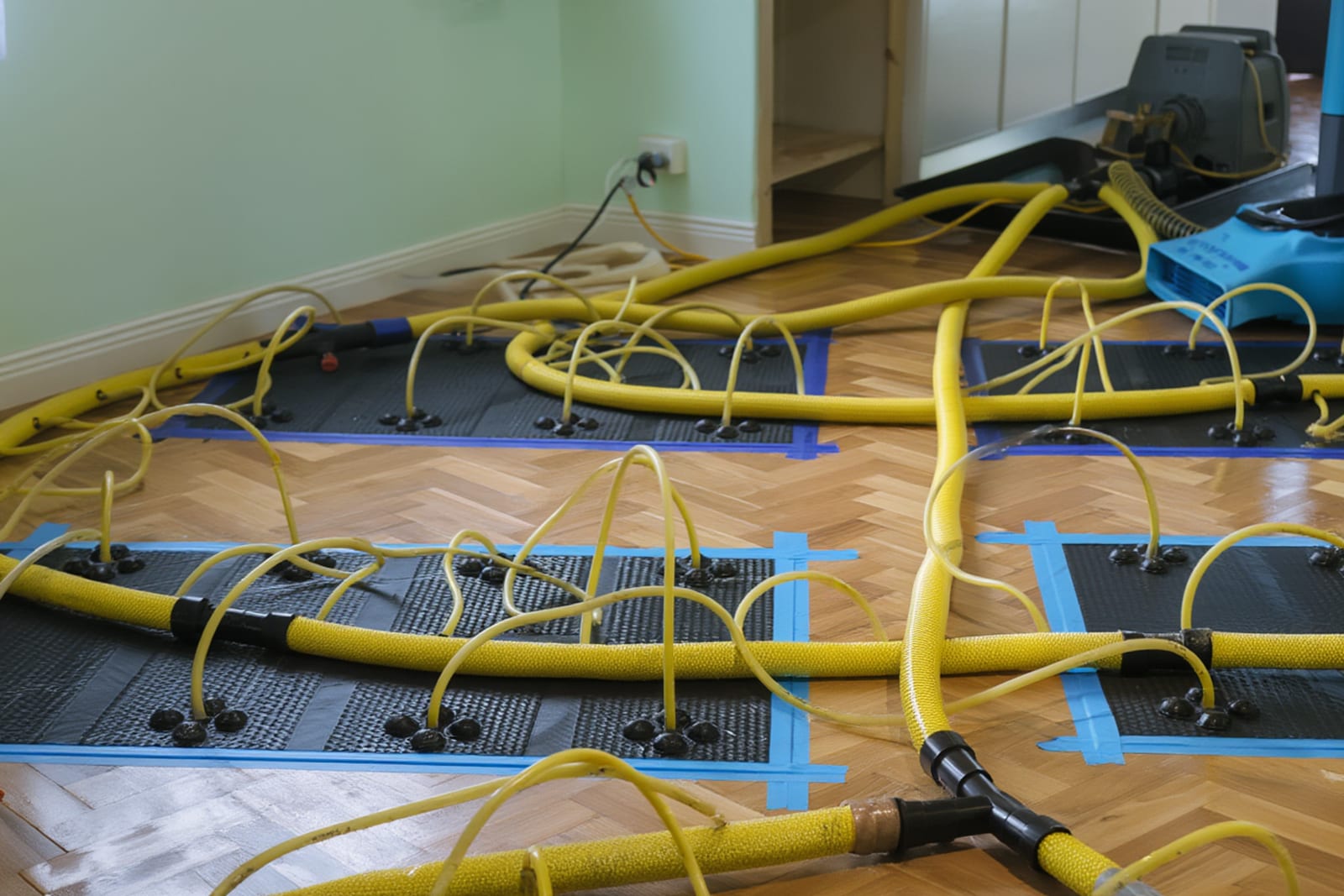
Bottom-side drying is the key to successful hardwood floor salvage. We use specialized drying mats (like the Injectidry HP system or Dri-Eaz floor drying panels) that are laid on top of the hardwood and create a sealed chamber. Warm, dry air is circulated beneath the mat, drawing moisture out of the wood from above while the dehumidifiers remove moisture from the surrounding air. This dries the wood more evenly and reduces the risk of permanent cupping.
Weighted drying systems apply gentle pressure to cupped boards during the drying process to encourage them to flatten as they dry. Sandbags, water-filled tubes, or purpose-built weighted mats are placed on the floor to resist the edges' tendency to stay raised.
Throughout the drying process, we take daily moisture readings at multiple points across the floor. We also measure the subfloor moisture content to ensure both layers are drying at compatible rates. LGR dehumidifiers maintain the room at optimal conditions — typically 40 to 50 percent relative humidity.
Hardwood floor drying typically takes 5 to 14 days — significantly longer than standard structural drying. Rushing this process to save time results in permanent floor damage. We keep equipment in place until readings confirm the wood has reached its target moisture content.
When Hardwood Floors Must Be Replaced
Replacement is the right call when:
- Engineered hardwood has delaminated. Once the veneer separates from the core, the board cannot be repaired. This is visible as blistering, lifting edges, or a hollow sound when tapped.
- Boards have cracked or split at the tongue-and-groove joints, making them structurally compromised.
- Mold has penetrated into the wood grain rather than sitting on the surface. Surface mold on solid hardwood can be sanded away during refinishing, but mold that has grown into the wood fibers cannot be fully removed.
- The subfloor requires replacement and the hardwood cannot be removed intact for reinstallation. This is common with glued-down floors on slab foundations.
- Severe buckling has caused permanent deformation — boards that remain twisted or warped after drying cannot be flattened.
When partial replacement is needed, matching the existing flooring is critical. We identify the wood species, grade, board width, and finish of your existing floor and source matching material. For older floors where the exact product is no longer available, we work with flooring suppliers who specialize in matching discontinued profiles.
Preventing Hardwood Floor Water Damage
Austin homeowners with hardwood floors can take several steps to reduce the risk of water damage:
- Install water leak sensors near dishwashers, refrigerators with ice makers, washing machines, and water heaters. These battery-operated devices alert you to leaks before significant damage occurs.
- Replace rubber appliance hoses with braided stainless steel. Rubber hoses are the number one cause of catastrophic appliance water damage and should be replaced every 5 years.
- Control indoor humidity. Austin's humid climate can cause hardwood to expand even without a water event. Keep indoor relative humidity between 35 and 55 percent year-round. A hygrometer in the room with hardwood helps you monitor conditions.
- Clean spills immediately. Standing water — even a small amount — begins penetrating hardwood finishes within minutes. Blot (do not mop) and dry the area completely.
- Maintain your floor finish. The polyurethane or other finish on your hardwood is the primary moisture barrier. Refinish when wear patterns show the bare wood is exposed, particularly in high-traffic and kitchen areas.
Frequently Asked Questions
Hardwood Floor Water Damage Repair — Service Areas
We provide hardwood floor water damage repair throughout the greater Austin metro area, including: Round Rock · Cedar Park · Georgetown · Pflugerville · Kyle · Buda · San Marcos · Leander · Lakeway. Contact us for service in your area.


