Why Our Structural Drying Approach Works
IICRC S500 Protocols
Every job follows the industry standard for water damage restoration — equipment selection, placement calculations, and dry-standard verification are all S500-compliant.
Daily Moisture Monitoring
We take readings at the same measurement points every day and plot a documented drying curve — so you and your adjuster can see progress, not just take our word for it.
Equipment Calculated Per Loss Class
Air mover and dehumidifier counts are calculated by affected area, material types, and IICRC loss class — not guessed. Right-sized equipment dries faster and avoids over-drying damage.
Insurance-Ready Documentation
Initial moisture map, daily logs, equipment records, and final dry-down verification — all formatted for adjusters and compatible with Xactimate from day one.
What Structural Drying Involves
Structural drying is not simply placing fans in a room and waiting. It is a controlled process of removing moisture that has been absorbed into building materials — drywall, framing lumber, subfloor, insulation, concrete — after standing water has been extracted. The goal is to return every affected material to its pre-loss moisture content, verified by instrument readings rather than guesswork.
The process begins immediately after water extraction is complete. Once standing water has been removed by pumps and extractors, the structure still holds a significant amount of moisture. Wood framing can absorb water for hours after the visible water is gone. Drywall wicks moisture upward by capillary action, often saturating two to three feet above the visible water line. This trapped moisture is what structural drying targets.
In Austin, where water damage restoration is complicated by high ambient humidity and warm temperatures, proper structural drying requires careful equipment placement, daily monitoring, and adjustments based on real-time psychrometric data. Every drying job is different, and the setup must account for the specific materials involved, the volume of water absorbed, and the conditions inside your home.
Equipment We Use: Dehumidifiers and Air Movers
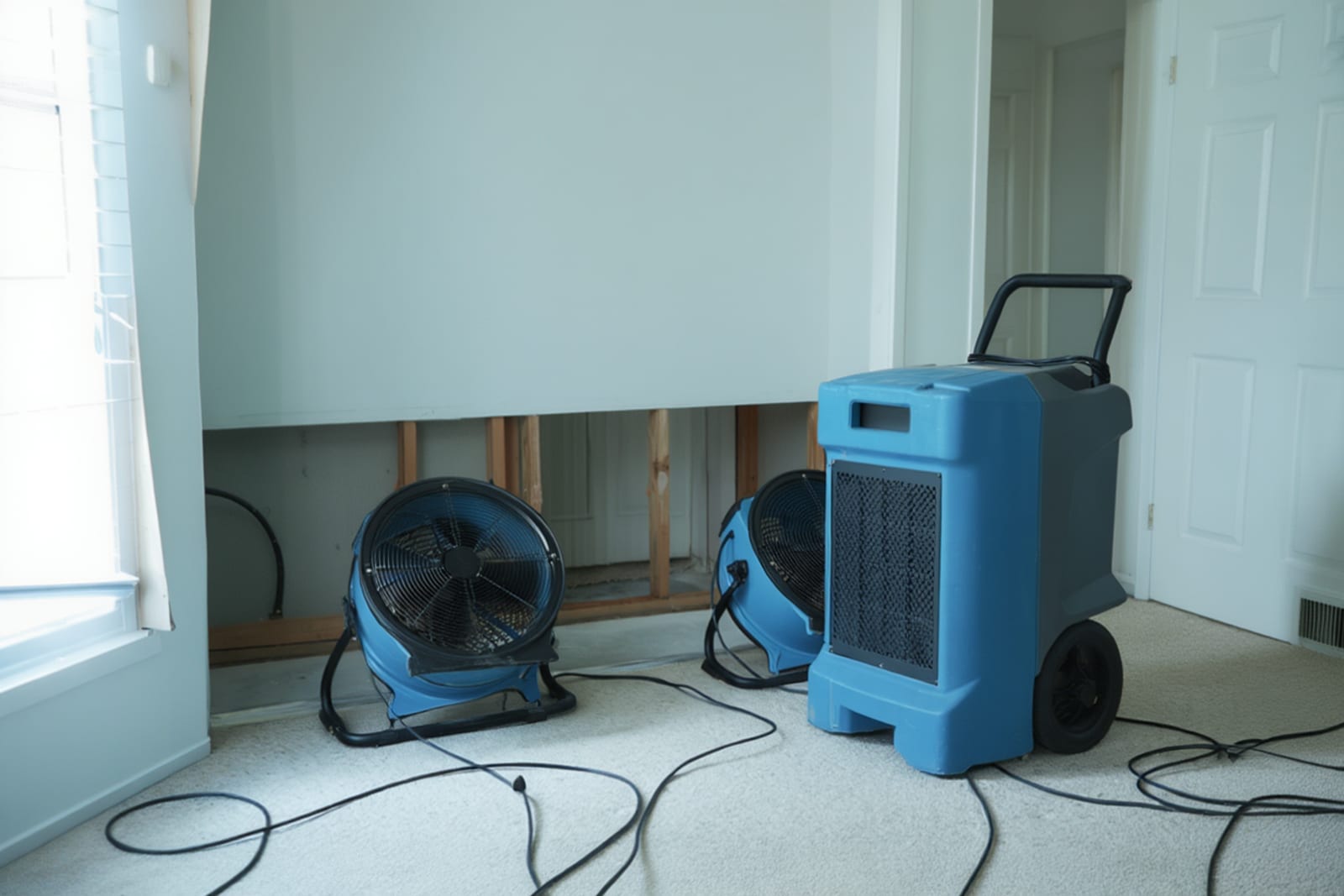
Professional structural drying relies on two categories of equipment working together: air movers and dehumidifiers. Neither is effective alone.
High-Velocity Air Movers
Positioned at specific angles to create airflow across wet surfaces, accelerating evaporation from drywall, wood, and carpet. We place one air mover for every 10 to 16 linear feet of wall, angled to create a vortex pattern that maximizes surface contact.
LGR Dehumidifiers
Industry-standard low-grain refrigerant units that extract 17 to 30 gallons of water per day. Essential for Austin jobs where outdoor relative humidity regularly exceeds 70 percent in summer.
Desiccant Dehumidifiers
Used for drying concrete slab foundations common in Austin homes. Achieves lower grain depression and pulls moisture from materials that LGR units struggle with at lower moisture levels.
Injectidry Systems
Dries wall cavities and under cabinets without removing materials unnecessarily. Delivers warm dry air directly into enclosed spaces through small access points.
Heated Drying Mats
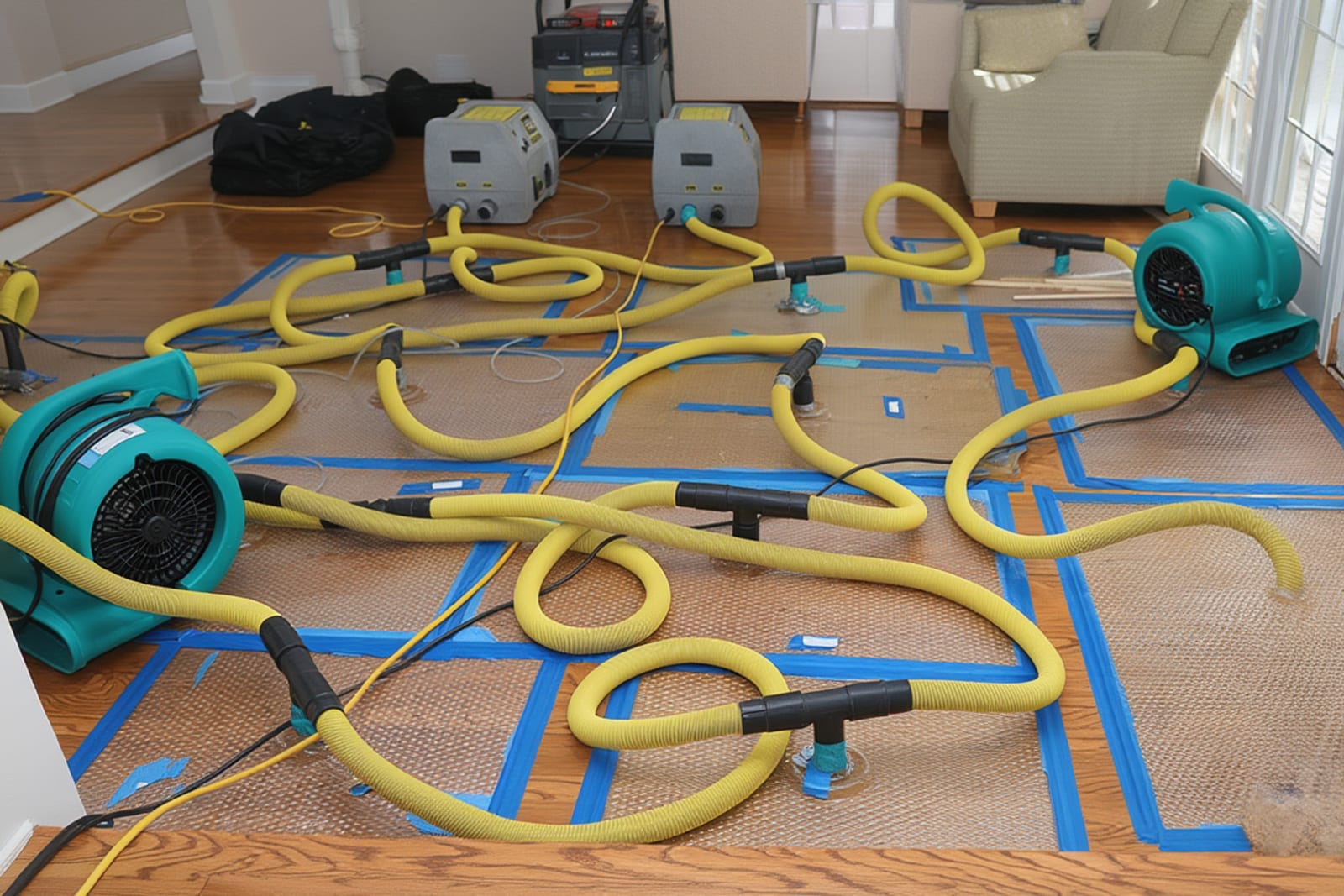
Specialized floor drying panels for hardwood floor salvage. Applies controlled heat from above to draw moisture evenly from wood without causing additional warping.
Need Professional Structural Drying? Call for an Assessment.
We calculate the right equipment for your loss, monitor daily, and document everything for your insurance.
Moisture Mapping: Finding Hidden Water
Before we place a single piece of equipment, we perform a comprehensive moisture survey of your home. This is not a quick walk-through — it is a systematic, room-by-room assessment using multiple instruments to build a complete picture of where water has traveled.
Pin-Type Moisture Meters
Measure moisture content at specific depths by inserting probes into the material. We use these on wood framing, baseboards, and subfloor to get precise readings.
Non-Invasive Capacitance Meters
Instruments like the Tramex Moisture Encounter scan large areas without penetrating the surface. Useful for mapping moisture behind tile, under vinyl flooring, and across drywall without creating holes.
FLIR Thermal Imaging
Detects temperature differences that indicate evaporative cooling — wet materials are cooler than dry ones. Lets us see moisture patterns behind walls, above ceilings, and under floors without any demolition.
Baseline Moisture Map
The initial moisture map becomes the baseline for the entire drying project. Every day, we take new readings at the same points and update the map to track progress.
This documentation is also critical for your insurance claim — adjusters want to see that drying was monitored systematically, not just assumed.
IICRC S500 Drying Standards Explained
The IICRC S500 is the industry reference standard for professional water damage restoration. Published by the Institute of Inspection, Cleaning and Restoration Certification, it defines the procedures, equipment requirements, and documentation practices that qualified restoration companies follow.
Key S500 principles that apply to every structural drying project:
- Dry standard determination: We measure unaffected materials of the same type in your home to establish a "dry standard" — the target moisture content. Affected materials are dried until they match these baseline readings, not an arbitrary number.
- Psychrometric monitoring: We track temperature, relative humidity, and grain depression (the difference between outdoor and indoor moisture levels) to verify that the drying environment is working effectively.
- Equipment calculation: S500 provides formulas for determining how many air movers and dehumidifiers are needed based on the affected area, material types, and class of water damage.
- Daily documentation: Moisture readings, equipment placement, atmospheric conditions, and any changes to the drying plan are logged daily. This creates a defensible record for insurance purposes.
Not every restoration company follows S500 rigorously. Some rely on experience and visual inspection rather than instrument-verified drying. The difference matters — both for the long-term integrity of your home and for your insurance claim documentation.
How Long Does Structural Drying Take in Austin's Climate?
Most residential structural drying projects in Austin take between 3 and 5 days. Several factors affect the timeline:
- Volume of water absorbed: A minor sink overflow affecting one room dries faster than a burst supply line that saturated an entire floor.
- Material types: Drywall and carpet dry relatively quickly. Hardwood flooring, concrete, and plaster take longer because they hold moisture more stubbornly.
- Structural complexity: Multi-layer assemblies — like a second-floor bathroom leak that has traveled through subfloor, ceiling joists, and the first-floor ceiling below — require more time and equipment.
- Austin's humidity: From late spring through early fall, outdoor humidity in Austin often sits between 60 and 85 percent. Dehumidifiers must overcome this ambient moisture to maintain effective drying conditions indoors. During drier winter months, drying tends to proceed more quickly.
We provide a projected timeline during the initial assessment, updated daily based on actual progress. If moisture readings plateau, we adjust equipment placement or add units rather than simply extending the timeline and hoping conditions improve.
Drying Logs and Documentation for Insurance
Every structural drying project we complete generates a detailed documentation package that includes:
- Initial moisture map with readings at every measurement point, including unaffected dry-standard readings
- Daily monitoring logs showing moisture progression at each point, atmospheric readings, and equipment status
- Equipment placement records documenting the type, quantity, and position of all drying equipment
- Photographs of affected areas before, during, and after drying
- Final dry-down verification confirming that all measurement points have reached or fallen below dry-standard readings
This documentation serves two purposes. First, it protects you during the insurance claims process — carriers want evidence that restoration work was performed to industry standards. Second, it protects you legally if any secondary damage appears later. A complete drying record demonstrates that proper protocols were followed.
We prepare this documentation in a format that insurance adjusters recognize, using industry-standard software like Xactimate and Encircle. If your carrier requests additional documentation, we can provide it promptly because our records are thorough from day one.


